

Organizing Brownfield Data Across Multiple Plants.


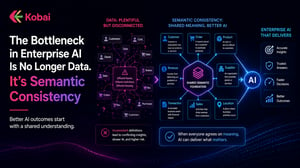
The Bottleneck in Enterprise AI Is No Longer Data. It’s Semantic Consistency
The Bottleneck in Enterprise AI Is No Longer Data. It’s Semantic Consistency
7:41
Organizations have invested heavily in data platforms, cloud infrastructure, and AI capabilities. The systems are capable. The data is there. And yet AI initiatives keep stalling at the same point, not because the technology failed, but because the business could not agree on what the data meant.
Ask your sales team what a “customer” is. Then ask your finance team. Then ask the AI agent running your account review workflow. You will get three different answers — each one internally coherent, none of them the same.
This is not a data problem. Every team has access to the same CRM, the same ERP, the same Databricks Lakehouse. The problem is that nobody has formally agreed on what “customer” means across those systems — whether it refers to a billing entity, a legal entity, a contract, or a relationship. Without that shared definition, every team builds its own interpretation. Every AI system inherits that inconsistency. And every cross-team decision requires a reconciliation meeting that should never have been necessary.
The bottleneck in enterprise AI is no longer data or compute. It is semantic consistency and it is increasingly cited by industry analysts as the reason AI initiatives stall not because of model quality or data availability, but because of absent or inconsistent shared meaning across the organization.
|
The bottleneck in enterprise AI is no longer data or compute, it’s semantic consistency. |
PART ONE
What semantic consistency actually means and why it matters now
Semantic consistency is the degree to which the people, systems, and AI tools in an organization share a common, reliable understanding of what their data means. Not just what it says, what it means.
It encompasses three things:
- Entity definitions — what is a customer, an asset, a product, a supplier? Where does one entity end and another begin?
- Relationship declarations — how do entities connect to each other? Which assets belong to which facilities? Which contracts govern which counterparties?
- Business rules — what constraints and logic apply? When is a risk threshold breached? What qualifies an engineer for a given asset class?
When these three things are formally declared and shared across the organization, AI systems can reason from them. When they are implicit, embedded in individual pipeline logic, or defined independently per team, AI systems construct their own interpretations. Those interpretations will be plausible. They will not be consistent. And in an enterprise operating at scale, inconsistency is indistinguishable from unreliability.
|
Why this is a new problem Ten years ago, inconsistent business definitions produced inconsistent dashboards. Annoying, but contained. Today, inconsistent business definitions produce inconsistent AI actions: an agent that recommends the wrong counterparty, a Genie space that contradicts the one in the next business unit, a predictive model that generalizes from the wrong entity class. The stakes of semantic inconsistency have risen in proportion to how much the enterprise is relying on AI to make consequential decisions. |
PART TWO
How we arrived here: the data decade and its unfinished business
The last decade of enterprise data investment was dominated by a single challenge: getting data into a governed, scalable platform. Data lakes, cloud data warehouses, and modern Lakehouse like Databricks solved that problem well. Data is more accessible, better governed, and more reliably available than it has ever been.
What that investment did not solve — because it was not designed to — was the question of what the data means. Platforms store data. They enforce access controls. They maintain lineage. But they do not declare that the “Customer_ID” column in the CRM and the “Client_Ref” column in the billing system refer to the same real-world entity. They do not specify that “revenue” in the sales region means gross revenue before returns, while “revenue” in the finance model means net of discounts. Those declarations belong to a layer that most organizations have not yet built: the semantic layer.
The platform vendors have recognized this. Databricks has positioned Business Semantics as platform infrastructure with the explicit goal of enabling teams to define semantics once and trust them everywhere, powering natural-language experiences like Genie and governed analytics across the Lakehouse. Snowflake has embedded Semantic Views as first-class schema objects. The message from the market is consistent: semantic consistency is becoming infrastructure, not a specialist addition.
|
Platforms store data and enforce governance. They do not define what the data means. That definition belongs to a semantic layer and the organizations that build it deliberately will have a structural advantage in enterprise AI. |
PART THREE
Where semantic inconsistency shows up in enterprise AI
Semantic inconsistency is not always visible until AI is deployed at scale. Here is where it tends to surface and what the operational cost looks like in each case.
In Genie and natural-language AI
As organizations deploy Genie across multiple teams and domains, the same question asked in two different Genie spaces can return two different answers. Not because the data is wrong, but because the business logic configured in each space reflects a different team’s interpretation of the same concepts. The technical infrastructure is shared. The business meaning is not. Maintaining consistent business context across Genie spaces as they proliferate is the central scaling challenge for enterprise conversational AI.
In agentic AI workflows
Agents that take consequential actions — prioritizing maintenance, routing procurement, flagging compliance risk — make decisions based on how they understand the entities they are acting on. An agent that has a different definition of “critical asset” from the maintenance team it is meant to support will make systematically wrong recommendations. Consistently. At scale. Without anyone necessarily knowing why, because the error is in the meaning layer, not in the model or the data.
In AI/BI and cross-team reporting
AI-generated insights in BI tools inherit the metric definitions of the systems they are built on. When those definitions vary across business units — different calculations for the same KPI, different entity boundaries for the same business concept — AI-generated summaries and recommendations will contradict each other. The problem is not the AI. It is the absence of a shared, governed definition that the AI can draw from consistently.
|
Where it surfaces |
The symptom |
The underlying cause |
|
Genie spaces across teams |
Same question, different answers by business unit |
Each space defines its own business logic independently |
|
AI agents |
Systematically wrong recommendations on consequential decisions |
Agent entity definitions differ from operational domain understanding |
|
AI/BI across functions |
Conflicting metrics and KPIs in AI-generated summaries |
No shared metric definition across the enterprise |
|
Cross-domain AI reasoning |
AI cannot answer questions that span two or more data domains |
Entity relationships across domains are not formally declared |
|
AI explainability |
Cannot trace AI answer to source data or reasoning logic |
Business rules embedded in pipeline code, not in a governed semantic model |
PART FOUR
What achieving semantic consistency actually requires
Semantic consistency does not happen by deploying a better model or investing in a faster platform. It requires deliberate organizational effort across four dimensions.
1. Shared entity definitions, authored by domain experts and accelerated by AI
The people who can define what a “customer” or an “asset” means operationally are not data engineers. They are the commercial leaders, reliability engineers, and operations managers who work with those concepts every day. Semantic consistency requires giving those people the tools to formally declare business definitions — not just describe them in documentation that nobody reads — in a form that AI systems can consume directly.
Historically, the challenge was not recognizing the need for semantic consistency. It was the time and effort required to create it. Building a semantic model from scratch required specialist skills, months of modelling effort, and a level of data engineering investment that most organizations could not sustain alongside their other priorities.
Kobai Precursor changes this. Precursor uses AI to accelerate semantic model creation by analyzing existing data sources and recommending entity definitions, relationship types, and mappings for domain experts to review, refine, and approve. The domain expert remains in control of what the model means and how it governs AI behavior. The time to a working semantic model compresses from months to days or weeks, making semantic consistency achievable as a first step, not a multi-year programme.
2. Relationship declarations across domains
Entity definitions without relationships are a glossary. Semantic consistency requires declaring how entities connect: which assets belong to which facilities, which engineers are certified for which asset classes, which products are governed by which contracts. Cross-domain questions — the ones that AI systems are increasingly being asked to answer — can only be answered when those relationship declarations exist in a traversable, governed form.
3. Governance that keeps definitions current
Business meaning changes. A regulatory update introduces a new constraint. An acquisition adds a new entity type. A product is discontinued. Semantic consistency is not a one-time achievement, it is a governance discipline. Definitions must be versioned, changes must be reviewed, and every AI consumer that depends on a definition must be updated when that definition changes. Treating context as a governed business asset with the same rigour applied to any other critical business system, is what makes semantic consistency durable.
4. Operationalization across every AI consumer
Shared definitions that live in a document or a data dictionary are not operationalized. Semantic consistency requires that business definitions are available to every AI consumer — Genie spaces, agents, AI/BI workflows, applications — in a form they can actually use. Defined once, consumed everywhere, updated consistently. That is the operating model that resolves the semantic inconsistency problem at enterprise scale.
|
Semantic consistency is not a technology purchase. It is an organizational capability — the discipline of defining, governing, and operationalizing shared business meaning across every system that depends on it. |
PART FIVE
Where this is heading: Semantic consistency as competitive infrastructure
The organizations that establish semantic consistency now — before their AI deployments scale to the point where inconsistency becomes an operational crisis — will have a structural advantage that compounds over time.
Every new AI use case deployed on a consistent semantic foundation is faster to stand up, because context does not need to be rebuilt from scratch. Every Genie space added draws from the same shared definitions, rather than introducing new drift. Every agent action is more reliable, because the entity understanding it is acting on is governed and current. Every compliance or explainability request can be answered, because the reasoning chain from AI output to business rule to source data is traceable.
The organizations without that foundation will face an increasingly expensive problem: a proliferation of AI systems, each with its own interpretation of the business, producing outputs that cannot be reconciled and decisions that cannot be defended. The technical debt of inconsistent semantics is not visible until AI is operating at scale. By then, it is very difficult to fix.
|
Enterprise AI without semantic consistency |
Enterprise AI with semantic consistency |
|
AI pilots succeed in isolation; fail to generalize across teams or domains |
AI use cases built on shared definitions scale from one team to the enterprise |
|
Different Genie spaces give different answers to the same question |
Every Genie space draws from the same governed business meaning |
|
Agents make decisions based on inconsistent entity understanding |
Agent actions grounded in formally declared, versioned business context |
|
AI explainability is reconstructed after the fact, if at all |
Traceability from AI output to business rule to source data is native |
|
New AI use cases require rebuilding business context from scratch |
New use cases connect to existing shared context — defined once, consumed everywhere |
|
Compliance teams cannot validate AI reasoning |
Governance of AI inputs is as visible as governance of AI outputs |
WHAT THIS DELIVERS
The business outcomes of semantic consistency
Semantic consistency is not an architectural goal. It is a precondition for a specific set of business outcomes that enterprise AI leaders care about. Making those outcomes explicit helps connect the investment in shared context to the results it produces.
|
Outcome |
What it means in practice |
|
Faster Genie deployments |
New Genie spaces connect to existing shared context rather than rebuilding business logic from scratch. Time to a production-ready Genie space reduces from weeks to days. |
|
Faster onboarding of new AI use cases |
Each new agent, workflow, or AI application draws from the governed semantic model. Context does not need to be re-created per use case, it is reused. |
|
More consistent AI answers |
Every AI consumer works from the same entity definitions and business rules. The same question asked in two different Genie spaces returns the same answer. |
|
Less reconciliation between teams |
When business meaning is shared and governed, cross-team AI outputs can be compared directly. Reconciliation meetings become exceptions rather than standard operating procedure. |
|
Reduced duplication of business logic |
Business rules defined once in the semantic model rather than embedded independently in every pipeline, dashboard, and agent configuration. Changes propagate automatically. |
|
Improved explainability and governance |
AI answers carry traceable lineage back through the semantic model to governed source data. Compliance teams can validate AI reasoning without a separate audit process. |
Databricks + Kobai: Building semantic consistency at enterprise scale
Databricks is helping enterprises bring context to AI with Business Semantics, Genie, and a platform architecture built to support shared business meaning at scale. Kobai helps enterprises create, govern, and operationalize that context as a managed business asset.
Kobai Precursor uses AI to accelerate semantic model creation, so domain experts can define shared business context in days rather than months. Kobai Studio gives those experts no-code tooling to author and maintain the model as the business evolves. Graph structures are built directly within Databricks under Unity Catalog governance, and the shared model is made available to every AI consumer — Genie, agents, AI/BI, and applications — through a single governed layer.
Semantic consistency is not the end goal. It is the precondition for enterprise AI that is trustworthy, scalable, and defensible. The organizations that build it now will find that every subsequent AI investment delivers more value, faster, with less reconciliation and more confidence.
|
To explore how Databricks + Kobai can help your organization build semantic consistency as a foundation for enterprise AI, visit kobai.io or contact us at contact@kobai.io. |

COMMENTS
