

Organizing Brownfield Data Across Multiple Plants.


Enterprise AI doesn’t fail because organizations can’t ingest data. It fails because onboarding new data sources is still slow, inconsistent, and expensive. At DAIS 2026, Mehul Bhuva from Corteva Agriscience showed how Databricks Lakeflow is helping change that.
Enterprise AI doesn’t fail because organizations can’t ingest data. It fails because onboarding new data sources is still slow, inconsistent, and expensive. Every new source requires custom engineering. Schemas differ. Governance requirements vary. And each new integration that takes weeks is a delay to the AI initiative that depends on it.
At DAIS 2026, Mehul K. Bhuva from Corteva Agriscience took to the stage to show what a different approach looks like. His session on accelerating data source onboarding with Databricks Lakeflow was one of the more practically grounded presentations of the summit — a real enterprise, a real challenge, and a real framework for solving it.
THE SPEAKER
Mehul K. Bhuva, Corteva Agriscience
With over two decades of experience, Mehul is a recognized Data & AI Platform Engineer, researcher, and thought leader in modern data architectures. His work consistently bridges the gap between enterprise data engineering and applied AI, helping organizations evolve from fragmented systems to intelligent, context-aware platforms.
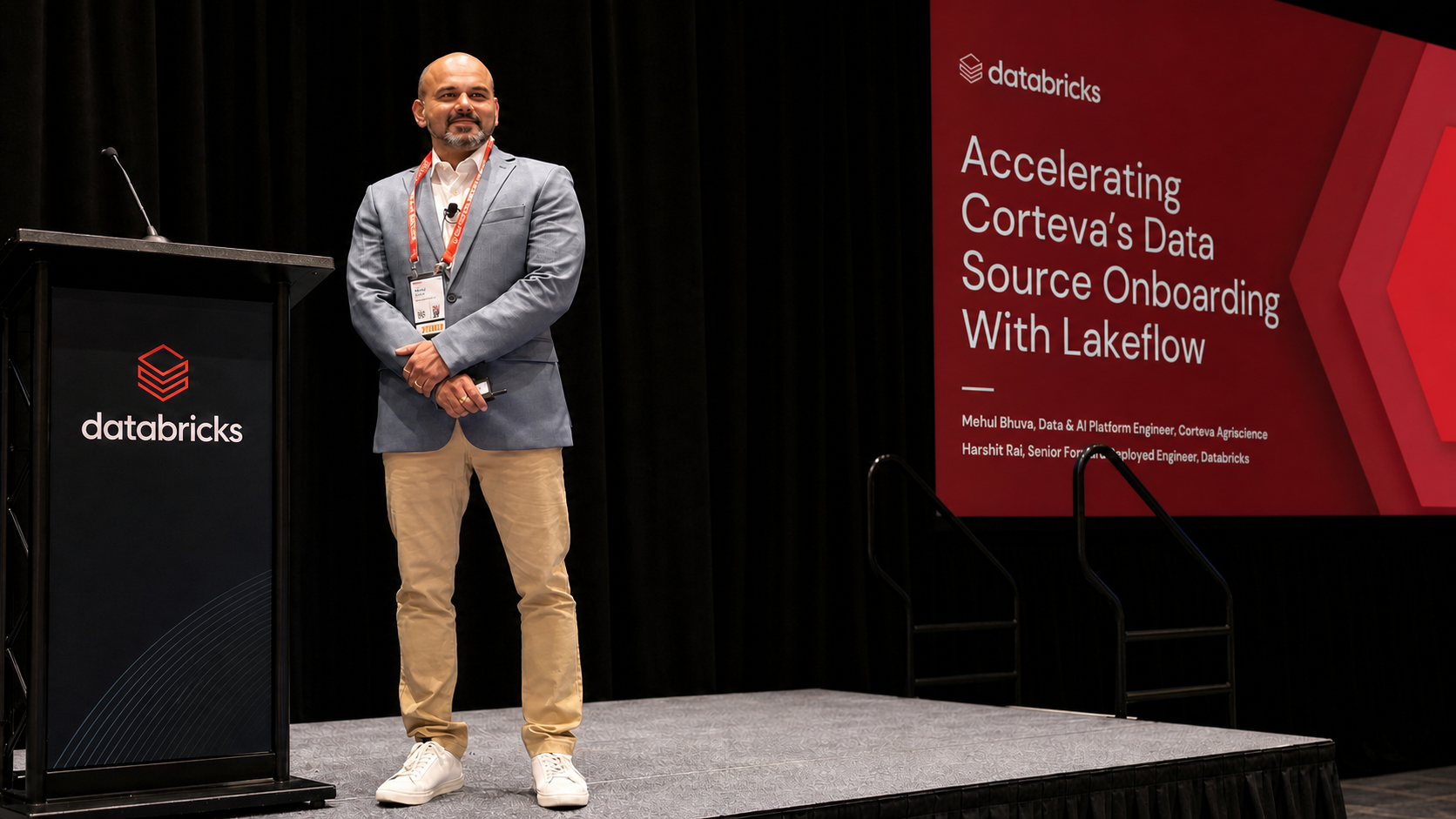
Known for his practical, automation-first approach, Mehul has built context-driven frameworks that operate at enterprise scale and his DAIS 2026 session is a direct reflection of that philosophy applied to one of the most persistent challenges in enterprise data: getting new sources onto the platform quickly and reliably.
THE CHALLENGE
Why data source onboarding is still a bottleneck
For large enterprises like Corteva — operating across global markets with diverse data sources, multiple business units, and strict governance requirements — data source onboarding is not a solved problem. Each new data source that needs to enter the platform represents an engineering effort: designing the pipeline, handling the schema, applying the right governance controls, and integrating with the downstream systems that depend on the data.
When that process is slow or inconsistent, it creates a compounding problem for enterprise AI. AI models that need new data sources wait. Genie spaces that should cover new domains cannot be extended. The platform’s capability grows faster than the business’s ability to onboard the data that would put it to work.
|
The onboarding challenge without standardization |
What it costs AI initiatives |
|
Each new source requires custom pipeline engineering |
Data engineering time that should go to AI goes to integration |
|
Governance applied inconsistently across sources |
Data from newer sources is trusted less; AI built on it is challenged |
|
Schema differences handled on a case-by-case basis |
Slower onboarding means slower access to the data AI models need |
|
No standardized framework across teams or business units |
Inconsistent data quality makes cross-domain AI harder to build |
THE SESSION
What Corteva built with Databricks Lakeflow
|
▶ Watch the session: Accelerating Corteva’s Data Source Onboarding with Lakeflow — DAIS 2026 |
Mehul’s session demonstrated how Corteva is using Databricks Lakeflow to standardize and accelerate data source onboarding across the enterprise. Rather than treating each new data source as a bespoke engineering project, Corteva has built a framework that applies consistent patterns: standardized ingestion pipelines, governed data flows, and a context-driven approach that ensures new data enters the platform in a form that downstream teams can reliably use.
Why Lakeflow matters for this problem
Databricks Lakeflow provides the orchestration and pipeline infrastructure that makes standardized onboarding feasible at enterprise scale. Rather than maintaining a collection of individually engineered pipelines, Lakeflow enables teams to define reusable ingestion patterns that can be applied across data sources consistently — with built-in governance, lineage, and observability. For an enterprise like Corteva, operating across diverse data sources and business domains, that standardization is the difference between onboarding that scales and onboarding that stays a bottleneck.
The broader principle Mehul demonstrated
What made the session compelling beyond the Corteva specifics was the broader principle it illustrated. Faster, more consistent onboarding is not just an engineering win — it is a business accelerator. Every data source that reaches the platform faster, with consistent governance applied from the start, is a source that AI initiatives can depend on sooner. The onboarding framework becomes the foundation that scalable AI is built on.
|
A standardized onboarding framework creates the conditions for establishing shared business context as new data enters the platform. It does not solve the meaning problem on its own — but it creates the right foundation for doing so. |
WHAT RESONATED WITH US
Onboarding is the first step. Understanding is what follows.
What resonated most with us in Mehul’s session was a distinction that often gets overlooked in data engineering conversations: the difference between getting data into the platform and making that data consistently understood across the enterprise.
|
Lakeflow gets data into the platform |
Kobai helps the enterprise understand what it means |
|
Ingesting data sources efficiently |
Defining what entities in that data mean |
|
Orchestrating pipelines with consistent governance |
Declaring how entities relate to each other across sources |
|
Onboarding new data sources at scale |
Making that data reusable across Genie, agents, and AI workflows |
|
Building the data foundation for AI |
Building the business context layer that makes AI trustworthy |
Mehul’s framework does the hard work of getting data onto the Databricks Lakehouse consistently. What builds on top of that — the shared business context that allows AI systems to understand what the data means, how entities relate, and what rules apply — is where Kobai focuses. The two are complementary. Standardized onboarding creates the right conditions for establishing shared business context. Shared business context is what makes that onboarded data genuinely useful for AI at scale.
KOBAI’S VIEW
A blueprint for modern data platforms
At Kobai, we are proud to spotlight leaders like Mehul who are driving meaningful progress on the practical challenges of enterprise data. His work at Corteva is not just an implementation success — it is a demonstration of how modern enterprises can rethink data onboarding, apply consistent governance from the start, and build the foundation that scalable AI requires.
Kobai extends the Databricks Lakehouse with the Business Context Layer that allows enterprise AI to understand how your business actually works — built directly within Databricks under Unity Catalog governance, consuming the data that Lakeflow and the Lakehouse make available.
|
If you’re modernizing your data platform on Databricks, Mehul’s DAIS 2026 session is well worth watching. It shows how standardized onboarding creates the foundation for scalable AI — and makes the case for why that foundation matters before the AI layer is built. The next step, once data is consistently on the platform, is ensuring it is consistently understood across the enterprise. That is the problem Kobai is designed to solve. ▶ Watch Mehul’s session: DAIS 2026 → Accelerating Corteva’s Data Source Onboarding with Lakeflow ▶ Explore Kobai: kobai.io · contact@kobai.io |

COMMENTS
