

Organizing Brownfield Data Across Multiple Plants.


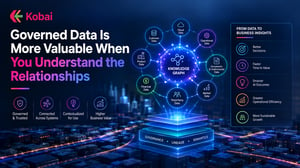
Governed Data Is More Valuable When You Understand the Relationships
Governed Data Is More Valuable When You Understand the Relationships
7:41
A governance review confirms that customer data is properly access-controlled and logged everywhere it appears. Every system checks out. What the review doesn't surface is a simpler, more useful question: are the "customer" records in the CRM, the billing system, and the support platform actually describing the same relationship with the same business, or three separate ones that happen to share a name?
Strong governance and a different kind of question
Governance, done well, answers a specific and important set of questions: who can access this data, where did it come from, and can we prove both if asked. Databricks provides a genuinely strong foundation for exactly that — consistent access control, automatic lineage, and governance that extends across tables, files, models, and agents alike.
Strong governance tells you a great deal about the data you have. It tells you less about how the customers, suppliers, assets, products, and other entities represented by that data relate to one another because that's a different kind of question, and one governance was never built to answer on its own.
Three places business relationships add to the governance picture
1. The customer represented differently across systems
The question: "Are the customer records in our CRM, billing platform, and support system describing the same underlying business relationship, or several distinct ones?"
Each system may govern its own customer records well. Access is controlled, lineage is tracked, everything checks out individually. Understanding that these records represent one business entity, rather than assuming they do because the names look similar, is a relationship question that sits alongside governance rather than inside it.
2. The supplier relationship nobody saw in the governance view
The question: "This supplier is linked to us through a subsidiary, a shared contract, and a facility we also work with under a different vendor record. Does our compliance review account for all of those connections?"
A vendor risk or compliance review typically examines one supplier record at a time, governed correctly on its own terms. Whether that supplier connects to the organization through other subsidiaries, contracts, or facilities, relationships that materially change the compliance picture, depends on understanding how supplier entities relate across the business, not on any single record's own governance.
3. The asset whose obligations depend on what it's connected to
The question: "This asset is well governed as data — access-controlled, lineage tracked. Which facility does it belong to, what process does it support, and which regulatory requirements follow from those connections?"
An asset record can be governed perfectly and still leave the more important question unanswered: what obligations apply to it, given where it sits in the business. That depends on its relationship to a facility, a process, and a jurisdiction — connections that live across systems the asset's own governance doesn't naturally traverse.
Two complementary disciplines
Strong governance tells you a great deal about the data you have. Business Context helps explain how the customers, suppliers, assets, products, and other entities represented by that data relate to one another.
Governance establishes control and trust around enterprise data. Business Context adds an understanding of the business entities and relationships represented by that data.
Databricks provides the governed foundation. Kobai adds reusable Business Context that helps applications, AI, and governance processes understand how those entities and relationships connect across that foundation available to inform a compliance review, a vendor risk assessment, or an audit, rather than replacing any of them.
A richer picture, not a new category
None of this requires treating Kobai as a governance, privacy, or compliance product in its own right. The value is narrower and more durable than that: making the business relationships around already-governed data explicit, so the people running governance, compliance, and audit processes have a fuller picture of how the entities they're reviewing actually connect.
Governance establishes trust in enterprise data. Business Context helps make the relationships represented by that data explicit and reusable. As AI begins to reason across more of the enterprise, organizations increasingly need both.

COMMENTS
