

Organizing Brownfield Data Across Multiple Plants.


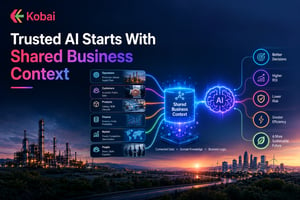
Trusted AI Starts With Shared Business Context
Trusted AI Starts With Shared Business Context
7:41
Most enterprise AI vendors talk about trust as something a product ships with — an explainability dashboard, a bias audit, a model card. Those are useful, but they miss where trust in AI actually comes from.
Trust is not a module you install. It is an emergent property of how an organization sources its data, governs its models, and responds when something goes wrong — built the way trust is built between humans, through consistent behavior over time.
The foundation trust depends on: shared, governed business meaning
Underneath most of the visible trust problems in enterprise AI — inconsistent answers, outputs nobody can fully explain, results that contradict each other depending on which system produced them — sits a more basic question the organization often hasn't answered: what does our data actually mean?
What counts as an "active customer"? What makes an asset "critical"? How does a customer relate to an order, a product, a supplier? If different teams and systems answer these questions differently, an AI system built on top of that inconsistency inherits it, and no amount of model-level tuning fixes a problem that originates in how the business itself defines its own concepts.
An AI system can only be as trustworthy as the business meaning it's reasoning from.
This is a major source of the inconsistent, difficult-to-explain answers that erode trust in enterprise AI — not the only cause, but one that's rarely addressed because it looks like a governance problem rather than a technical one. Provenance, explainability, and consistency are usually discussed as properties of a model. In practice, they depend just as much on whether the entities and relationships the model reasons about were ever defined once, consistently, and governed the way the underlying data is.
This is the architectural principle worth taking seriously: a governed, shared definition of an organization's core entities and relationships, its Business Context Layer, sitting between raw data and the models consuming it. When that layer exists, an AI system's outputs can be traced back to definitions the business itself recognizes, rather than to whatever a given engineer assumed "active" or "critical" meant when they wrote a query. Trust, in other words, is substantially a business context problem as much as a governance process, solved by making meaning explicit and shared rather than implicit and scattered across a hundred disconnected pipelines.
What this means beyond the data layer
Getting the business context foundation right doesn't replace the other things trust requires — clear ownership when something goes wrong, monitoring that runs continuously rather than once a year, and a real path for someone affected by a decision to challenge it. Those remain organizational commitments, not something any platform provides on its own.
But an organization that hasn't agreed on what its own data means will struggle to make any of those other commitments stick, because accountability and explainability both depend on being able to trace an output back to a definition someone can actually stand behind. Governance without shared meaning is only half the solution.
Where to start
- Establish durable ownership — someone with real authority to slow down a launch, not just a seat at the table.
- Govern business meaning before the model layer — agree on core entities and relationships before layering AI on top — unglamorous work, but where trust is often won or lost.
- Build a real path for challenge — make sure a contested AI decision reaches someone who can actually change the outcome.
- Measure the capability, not just the output — how quickly can a questionable answer be traced to its source? That tells you more than any single fairness score.
A feature ships once. A capability and the shared business context it depends on compounds.

COMMENTS
