

Organizing Brownfield Data Across Multiple Plants.


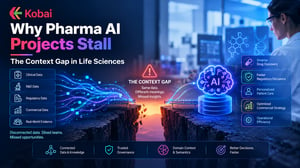
Why Pharma AI Projects Stall: The Context Gap in Life Sciences
Why Pharma AI Projects Stall: The Context Gap in Life Sciences
7:41
The safety signal was detected exactly as designed. Understanding its full impact meant connecting information across clinical, quality and manufacturing systems.
A signal can be right without telling you the whole story
Picture a clinical safety team monitoring an investigational therapy.
An unusual pattern of adverse events is detected across several patients. The signal itself is important, but understanding it requires a broader set of questions.
Which trial sites were those patients enrolled through? Which protocol version was active at the time? Which product batches were administered? Were there common manufacturing or handling characteristics?
The answers may exist across clinical, quality and manufacturing data. The challenge is understanding the relationships between them quickly enough to support the investigation.
This is an illustrative scenario, not a specific customer engagement, but it demonstrates an important challenge for life sciences AI:
Detecting a signal and understanding its full business and operational context are different problems.
As AI becomes more capable, the ability to connect information across domains becomes increasingly important.
Three places the context challenge appears
1. A safety signal that crosses clinical and manufacturing domains
The operational question:
"We're seeing an unusual adverse-event pattern. What relationships exist between the affected patients, trial sites, protocol versions and product batches?"
Answering that question may require connecting information managed across clinical operations, safety, quality and manufacturing.
The individual records may already be available and well governed. What matters during an investigation is being able to understand the relationships between them.
Patient → trial site → protocol version → product batch.
Making those relationships explicit and reusable can give safety and clinical teams a more connected view of the circumstances surrounding a signal.
2. A quality issue whose impact depends on the supply chain around it
The operational question:
"A raw material lot has been associated with a quality issue. Which finished product batches used it, and where were those batches subsequently distributed?"
The answer isn't contained in a single record.
It depends on a chain of relationships:
Raw material lot → manufacturing process → finished product batch → distribution destination.
Each part of that chain may be managed by different systems and teams.
Understanding the potential impact of a quality issue therefore requires more than identifying the original lot. It requires understanding everything connected to it downstream.
That connected context can support quality and recall-management processes in assessing the potential scope of an issue.
3. A protocol amendment with consequences beyond the protocol itself
The operational question:
"We've amended this trial protocol. Which related submissions, sites and consent materials may also need to be reviewed?"
A protocol amendment may be carefully controlled within the system responsible for managing it.
But the implications of that change can extend into other domains.
Protocol version → trial site → regulatory submission → jurisdiction → consent documentation.
Making those relationships visible can help clinical and regulatory teams understand where a change may have downstream consequences, rather than reconstructing those dependencies manually each time.
The challenge is increasingly cross-domain
None of these examples requires the underlying systems to be failing.
Clinical platforms can manage trials effectively. Quality systems can manage manufacturing records. Regulatory platforms can manage submissions. Safety systems can identify and investigate signals.
The challenge emerges when a question crosses the boundaries between them.
A safety question becomes a manufacturing question.
A quality issue becomes a distribution question.
A protocol change becomes a regulatory question.
The most valuable context often exists in the relationships between those domains.
Building on the Databricks foundation
Databricks provides a governed Data + AI foundation through which life sciences organizations can bring together data for analytics and AI, with Unity Catalog providing governance and Databricks continuing to expand its capabilities around semantics and context.
As organizations build more sophisticated AI and analytical use cases on that foundation, another challenge becomes increasingly important:
How do you make complex business relationships reusable across domains and use cases?
A safety investigation shouldn't have to rediscover the relationship between a patient, trial site, protocol and product batch every time a new question arises.
Likewise, a quality workflow shouldn't have to reconstruct the relationships between raw materials, manufacturing processes and finished products from scratch for every investigation.
These relationships are part of the organization's operational knowledge.
Making them explicit and reusable creates a richer foundation for AI, analytics and human decision-making.
From governed data to reusable Business Context
This is where Kobai fits.
Kobai provides a Business Context Layer for creating and maintaining connected Enterprise Context across complex entities, relationships and domains.
In life sciences, that could include relationships between concepts such as:
Patient → Trial Site → Protocol → Product Batch
Raw Material → Manufacturing Process → Finished Product → Distribution
Protocol → Site → Submission → Jurisdiction
The objective isn't to replace pharmacovigilance, clinical trial management, quality management or regulatory systems.
It is to make relevant business relationships available as reusable context that can support the teams, applications and AI experiences working across those domains.
That distinction matters.
Kobai isn't the system detecting the safety signal or making the regulatory decision. It helps provide a connected understanding of the entities and relationships surrounding those processes.
From detecting a signal to understanding its impact
As life sciences organizations expand their use of AI, some of the most valuable questions will increasingly cross traditional system and organizational boundaries.
A signal may begin in safety and lead into clinical operations.
A quality event may begin in manufacturing and extend into distribution.
A protocol change may begin in clinical development and create implications across multiple regulatory jurisdictions.
The underlying data matters.
But so do the relationships that explain how one part of the organization connects to another.
Detecting the signal is only the beginning. Acting on it effectively depends on understanding the relationships around it.

COMMENTS
