

Organizing Brownfield Data Across Multiple Plants.


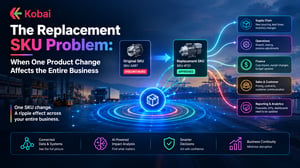
The Replacement SKU Problem: When One Product Change Affects the Entire Business
The Replacement SKU Problem: When One Product Change Affects the Entire Business
7:41
A new product is ready to launch. But is the rest of the business ready for it?
A consumer goods manufacturer replaces an existing product with a new formulation and updated packaging.
The product team has approved the change. The new SKU is in the product catalogue. Manufacturing is preparing for the transition.
But one of the company's largest retailers is still running a promotion against the old SKU.
The replacement hasn't yet been approved for that retailer's assortment. A standing replenishment order still references the discontinued item, and the demand plan assumes the transition will happen on schedule.
Individually, these may be manageable issues.
Together, they could mean missed sales, unavailable stock, wasted promotional investment and a frustrated retail customer.
The product change was straightforward. Understanding everything it affected was not.
A product is more than its SKU
In consumer packaged goods, a SKU is rarely just a product identifier.
It sits within a network of commercial and operational relationships.
A product may be associated with particular retailers, regions, distribution centres, promotional agreements, packaging requirements, pricing structures and replenishment arrangements.
When a SKU changes, some of those relationships may carry forward. Others may need to be reviewed, amended or replaced.
Consider a manufacturer introducing a new pack size to replace an existing product.
The product information system records the new SKU and its relationship to the discontinued item.
But that doesn't necessarily tell the business whether:
- The replacement is approved for every retailer carrying the original product.
- Existing promotions and trade agreements apply to the new pack size.
- Distribution centres have the right inventory available for the transition.
- Customer orders and replenishment arrangements need to be updated.
- The change affects shelf space, pricing or other retailer-specific requirements.
Each question may involve a different team and a different enterprise system.
The challenge is understanding how the answers connect.
The commercial risk sits between systems
Imagine a retailer has agreed to a six-week promotion for a particular product.
Halfway through the promotional period, the manufacturer begins transitioning to its replacement SKU.
The manufacturer may have sufficient inventory of the new product. But the retailer's promotional agreement references the original SKU, and the replacement has not yet been included in the approved assortment.
The problem isn't necessarily a lack of stock. It's that the commercial arrangements and operational plans haven't moved together.
Sales may know about the promotion. Supply chain may know about the product transition. Product management may know about the replacement.
But identifying the potential conflict requires understanding the relationships between all three.
This creates questions that are difficult to answer from any one dataset:
- Which active promotions are associated with products being replaced?
- Which retailers have approved the replacement, and which haven't?
- Where could the transition create a gap between available inventory and expected demand?
- Which customer orders or replenishment arrangements may need attention?
These are the kinds of questions that become more important as consumer goods companies manage larger product portfolios across multiple retailers, markets and distribution networks.
Understanding the relationships behind the change
The relationships involved in a product transition aren't always linear.
An old SKU may have more than one replacement, depending on the retailer, market or packaging configuration.
A new product may be commercially equivalent in one market but require separate approval in another.
A promotion may apply to a specific pack size rather than the broader product family.
Understanding the transition therefore means connecting several types of business information.
- Product relationships: Which items replace, supersede or belong to the same product family?
- Customer relationships: Which retailers and distribution channels carry each item?
- Commercial relationships: Which promotions, prices and agreements reference those items?
- Operational relationships: Which inventory locations, replenishment plans and customer orders depend on them?
Together, these relationships describe how a product operates within the business.
Making them explicit and reusable can help teams investigate the consequences of a change without having to reconstruct the same connections independently.
Making product context reusable
This is where Kobai's approach to Enterprise Context becomes relevant.
Kobai provides a Business Context Layer focused on creating and maintaining connected relationships across business entities and domains.
For a consumer goods company, those entities might include products, SKUs, retailers, distribution centres, promotions, agreements and customer orders.
Rather than viewing each as an isolated record, organizations can represent the relationships connecting them as reusable business context.
For example, understanding a SKU replacement may involve connecting:
Original SKU → Replacement SKU → Retailer Assortment → Promotional Agreement
Alongside relationships involving inventory, customer orders and replenishment plans.
Those connections can provide a more complete starting point for investigating the potential commercial and operational consequences of a product change.
Kobai doesn't replace product information management, ERP, inventory planning or trade promotion systems.
Nor does it automatically approve replacement products, change retailer assortments or execute commercial decisions.
Its role is to help organizations make the relevant business relationships explicit and reusable, supporting the teams and applications that need to understand how changes in one domain may affect another.
Building on the Databricks foundation
Databricks provides a governed Data + AI foundation for enterprise analytics and AI, including capabilities for data engineering, governance, semantics and natural-language data experiences.
For consumer goods companies, that foundation can support analysis across product, supply chain, sales and commercial data.
Kobai complements those capabilities by focusing on connected Enterprise Context: the relationships between business entities that may span multiple domains and use cases.
The objective isn't to introduce a competing definition of business meaning or replace existing Databricks capabilities.
It's to help make complex cross-domain relationships reusable as organizations develop more sophisticated analytics and AI applications.
In the SKU replacement example, those relationships can provide context for investigating which retailers, promotions, orders and operational plans may be affected by a product transition.
A better way to manage the consequences of change
Return to the retailer promotion.
The manufacturer is introducing a replacement product, but the retailer still has an active promotion against the old SKU.
With the relevant product, customer and commercial relationships represented and maintained, teams have a better starting point for identifying the potential conflict.
They can investigate which promotions reference the original product, which retailers have approved the replacement and which orders or inventory plans may require attention.
The decisions still belong to the people responsible for them.
Retailer approval may be required. Promotional terms may need renegotiation. Inventory may need to be reallocated.
Connected Enterprise Context doesn't eliminate those tasks. It can help teams understand the dependencies behind them earlier and with less effort.
And the same relationships can be useful beyond product replacements including packaging changes, supplier substitutions, assortment reviews and new product introductions.
The real challenge isn't changing the product
Consumer goods companies constantly introduce, reformulate, repackage and retire products.
Managing those changes requires coordination across product management, manufacturing, supply chain, sales and retail execution.
The difficult part isn't always making the change in the system responsible for it. It's understanding what that change means for the other parts of the business.
A replacement SKU may look like a small product update. But its consequences can extend across retailer agreements, promotional activity, inventory and customer commitments.
The more connected the business becomes, the more important it is to understand the relationships behind every change.
Making those relationships explicit and reusable can help organizations manage product transitions with greater visibility, consistency and confidence.

COMMENTS
