

Organizing Brownfield Data Across Multiple Plants.


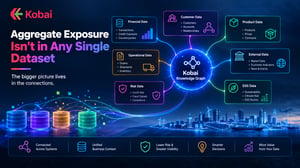
Aggregate Exposure Isn't in Any Single Dataset
Aggregate Exposure Isn't in Any Single Dataset
7:41
A credit downgrade can be reported in seconds. Understanding the relationships behind an institution's exposure can be considerably more complicated.
A major corporate borrower is downgraded.
Across the financial institution, risk teams begin assessing the implications.
Lending reviews outstanding loans. Markets examine derivatives positions. Treasury considers credit facilities and other commitments.
Each business line has information about its exposure. But understanding the institution's position across the wider corporate group requires another dimension: the relationships between the legal entities involved.
A subsidiary may have a different name from its parent. A holding company may sit between several operating businesses. Guarantees and other contractual arrangements may create connections that ownership alone doesn't explain.
The challenge isn't simply bringing together more exposure records.
It's understanding the relationships that determine how those records should be interpreted.
The complexity behind a corporate group
Consider a multinational business operating through dozens of legal entities across multiple jurisdictions.
Some subsidiaries borrow directly. Others enter into derivatives contracts. Certain entities provide guarantees for obligations elsewhere in the group.
For a financial institution assessing its exposure, several questions become important:
- Which legal entities belong to the wider corporate group?
- What ownership, control and guarantee relationships connect them?
- Which business lines hold exposures to those entities?
- Where might concentrations or dependencies require closer examination?
These questions span counterparty reference data, legal entity hierarchies, lending systems, trading platforms and risk management processes.
Financial institutions already invest significantly in managing this information. The difficulty is maintaining a consistent, current understanding of complex relationships as corporate structures, contracts and exposures change.
An ownership relationship may be straightforward to record. Its implications for credit risk may be anything but.
For example, two subsidiaries may share a parent without sharing the same legal obligations. A guarantee may connect entities that would otherwise be assessed separately. A change in ownership may alter how a group is viewed for particular risk or regulatory purposes.
Understanding the corporate structure is an essential input to exposure analysis. It isn't a substitute for the financial and legal analysis itself.
Why connected relationships matter
Imagine a borrower has been downgraded following deteriorating financial performance.
The institution needs to determine whether the event has implications beyond its direct lending relationship.
A useful starting point is understanding how the borrower connects to other entities and exposures across the institution.
That may involve relationships such as:
Corporate Group → Legal Entities → Credit Facilities and Positions
Alongside those relationships sit ownership interests, guarantees, collateral arrangements and other contractual dependencies.
The important point is that this isn't a single, simple hierarchy.
It's a network of relationships, with different connections carrying different business, legal and risk implications.
Making those relationships visible can help teams investigate where exposure exists, identify potential concentrations and determine which positions require further assessment.
It does not automatically establish aggregate exposure. That calculation still depends on the institution's applicable methodologies, netting arrangements, collateral, guarantees and other relevant factors.
But a more connected understanding of the entities involved can make the investigation more efficient and consistent.
From separate records to reusable Enterprise Context
Much of the information needed for these investigations already exists within financial institutions.
Legal entity reference data identifies counterparties. Lending platforms record facilities and balances. Trading systems maintain positions. Risk platforms apply exposure calculations and methodologies.
The challenge is making the relevant relationships between those domains consistently available.
A legal entity may appear in several systems under different identifiers. Ownership structures may change following acquisitions or reorganizations. Guarantees may create important connections that aren't apparent from a conventional parent-subsidiary hierarchy.
These relationships need to be understood, validated and maintained.
When represented as reusable Enterprise Context, they can support multiple business questions rather than being reconstructed independently for each investigation.
For example, the same connected understanding of corporate entities and their relationships may be relevant when examining counterparty concentration, reviewing a corporate restructuring or investigating the implications of a credit event.
The underlying analysis may differ, but the relationships connecting the entities remain important.
Building on the Databricks foundation
Databricks provides a governed Data + AI foundation for bringing together and working with enterprise data.
Through capabilities including Unity Catalog, data engineering, analytics and AI, financial institutions can develop governed data products and analytical workloads across their businesses.
Databricks is also expanding its capabilities around semantics and context, helping organizations make enterprise data more accessible and useful for analytical and AI applications.
As institutions develop more sophisticated use cases, an important question is how to make complex business relationships reusable alongside that governed foundation.
For counterparty exposure analysis, this means more than consistently defining a legal entity, facility or position.
It means understanding how those entities and records connect across business lines, ownership structures and contractual arrangements.
Those relationships form part of the institution's business knowledge.
Making them explicit and reusable can help teams work with a more connected view of the information relevant to their decisions.
Where Kobai fits
Kobai focuses on creating and maintaining connected Enterprise Context across business entities, complex relationships and domains.

COMMENTS
