

Organizing Brownfield Data Across Multiple Plants.


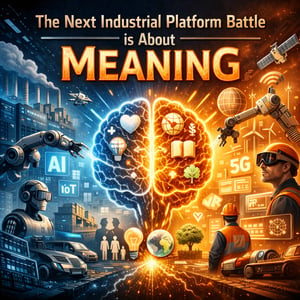
The Next Industrial Platform Battle Is About Meaning
The Next Industrial Platform Battle Is About Meaning
7:41
For years, industrial companies have been trying to solve the same problem: get the data connected.
Operational systems, historians, engineering tools, maintenance systems, enterprise applications — everything moving toward the cloud.
And in many ways, that part has worked.
Today, most large industrial organizations can move enormous volumes of operational and engineering data into modern platforms like Databricks or Snowflake relatively successfully.
But something interesting is happening now.
The conversation is shifting away from:
“How do we connect more data?”
toward:
“Why is it still so difficult to create shared understanding from it?”
Because the hard part was never really storage.
The hard part is meaning.
A centrifugal pump in one facility may look completely different in another. Different naming standards. Different hierarchies. Different engineering assumptions. Different historian structures. Different operational context.
Humans can usually work through that ambiguity.
AI struggles badly with it.
And that becomes a major problem as industrial organizations try to scale copilots, AI assistants, agentic workflows, predictive systems, and operational intelligence across the enterprise.
Connected systems are not the same as connected understanding.
That distinction matters more than most people realize.
At the same time, nearly every major industrial software company is now building some version of an industrial intelligence platform or industrial cloud ecosystem.
That strategy makes perfect sense from the vendor perspective.
But I increasingly wonder whether large industrial enterprises actually want another centralized operational silo — especially when most already operate highly heterogeneous environments spanning:
- AVEVA
- Hexagon / Octave
- SAP
- Maximo
- AspenTech
- custom OT
- multiple EPC systems
- multiple historians
- multiple clouds
- enterprise AI platforms
No single vendor owns the operational landscape anymore.
And realistically, none of them are going to.
That’s why I suspect the future of industrial intelligence looks far more federated than centralized.
Operational systems will remain distributed.
Enterprise AI platforms like Databricks and Snowflake will continue to provide scalable compute, analytics, and AI services.
But the missing layer increasingly becomes semantic context — the ability to create shared industrial meaning across all of those systems.
Because AI does not just need access to data.
It needs to understand:
- what assets represent
- how systems relate
- which definitions are trusted
- how engineering and operational concepts connect
- how meaning spans the enterprise
Without that, organizations risk building highly connected systems that still produce inconsistent answers.
And that’s the real challenge emerging now.
The next industrial platform battle probably will not be won by the company that stores the most data.
It will be won by the architectures that connect industrial meaning most effectively.
Because ultimately:
Connected data is not the same as connected understanding.
COMMENTS
