

Organizing Brownfield Data Across Multiple Plants.


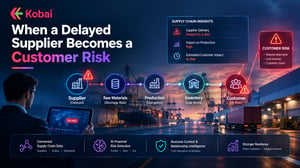
When a Delayed Supplier Becomes a Customer Risk
When a Delayed Supplier Becomes a Customer Risk
7:41
A supplier reports a two-week delay on a critical component.
Procurement knows about it. Manufacturing may already be adjusting its schedule. But does anyone know which customer deliveries are now at risk?
The answer depends on more than the delayed component.
That component may be used in several assemblies, each feeding different products, customer orders and contractual commitments.
The supplier delay is visible immediately. Understanding its full business impact can take considerably longer.
The challenge isn't simply knowing what happened. It's understanding everything connected to it.
The relationships behind a supplier delay
Consider a manufacturer producing complex industrial equipment.
A supplier announces that a component will arrive two weeks late. Procurement can identify the affected purchase order. Manufacturing can determine which assemblies require the component. Sales and customer operations can see upcoming delivery commitments.
But answering one question may require information from all three:
"Which customer commitments are at risk because of this supplier delay?"
The answer depends on a connected chain:
Supplier → Component → Assembly → Finished Product → Customer Order → Delivery Commitment
Each relationship may be recorded in a different enterprise system.
Procurement manages suppliers and purchase orders. Manufacturing manages bills of material and production schedules. Commercial teams manage customer orders and commitments.
The individual systems may be working exactly as intended.
The difficulty emerges when a business question crosses the boundaries between them.
Why the delay matters beyond procurement
A supplier delay doesn't affect every customer equally.
One affected product might have sufficient inventory to absorb the disruption. Another may be scheduled for production next week. A third may be associated with a contractual delivery deadline.
Without understanding those relationships, teams can struggle to distinguish an inconvenience from a significant customer risk.
That can affect several decisions:
- Which production orders should receive priority?
- Where would expediting a shipment make the greatest difference?
- Which customer commitments need further investigation?
- Which account teams should be informed about potential delivery exposure?
These aren't simply procurement questions.
They are business questions that connect suppliers, manufacturing operations, inventory, products and customers.
And answering them consistently requires an understanding of how those parts of the business relate to one another.
Building on a governed Data + AI foundation
Databricks provides a strong foundation for bringing enterprise data together for analytics and AI.
Through capabilities including Unity Catalog, Lakeflow, AI/BI and Genie, organizations can govern, prepare and use data across an expanding range of workloads.
Databricks is also advancing its semantic and context capabilities, helping organizations make governed data more useful for business users and AI applications.
These capabilities are important foundations for enterprise AI.
As organizations expand across more domains and use cases, another challenge becomes increasingly relevant:
How do we make complex relationships across the business explicit and reusable, rather than reconstructing them for each new question?
In our supplier example, the issue isn't simply understanding what a component or customer order means.
It's understanding how a particular supplier disruption could affect production, inventory and customer commitments through a series of connected relationships.
Making Enterprise Context reusable
This is the problem Kobai focuses on.
Kobai provides a Business Context Layer for creating and maintaining connected Enterprise Context across business entities, relationships and domains.
In the manufacturing example, that means representing the relationships between suppliers, components, assemblies, products, orders and commitments as connected business knowledge.
Rather than treating each relationship as an isolated piece of information, organizations can develop a reusable representation of how those entities connect.
That context can help teams and applications investigate questions that span procurement, manufacturing and commercial operations.
Importantly, Kobai isn't replacing the systems managing suppliers, production or customer orders. Nor is it replacing the governance, analytics, semantics or AI capabilities of Databricks.
Its role is to complement that foundation by helping organizations make complex cross-domain business relationships reusable.
From identifying a delay to understanding its impact
Return to the original scenario.
A supplier reports a two-week delay.
With the relevant business relationships represented and maintained, teams have a better starting point for understanding the potential consequences.
They can investigate which assemblies depend on the component, which products are affected, and which customer orders may require attention.
That doesn't eliminate the need to assess inventory, production alternatives, contractual obligations or other operational constraints.
But it can reduce the effort required to reconstruct the relationships behind those decisions.
And when another supplier disruption occurs, the organization can draw on the same maintained business context rather than starting from an entirely disconnected set of records.
The value extends beyond supply chain disruption.
The same principle applies when organizations need to understand how an asset failure affects operations, how a product change affects customers, or how a manufacturing issue affects delivery commitments.
In each case, the question crosses business domains.
And the relationships between those domains become essential to understanding the consequences.
The bigger opportunity
Enterprise AI is becoming increasingly capable of working with governed data.
But many of the questions that matter most to a business don't fit neatly within a single dataset, application or department.
They require understanding how the business is connected.
For manufacturers, that might mean tracing a supplier delay through production to a customer commitment.
For other industries, it might mean connecting assets to operational dependencies, or organizations to contracts and financial exposures.
The underlying principle is the same.
The value isn't just knowing that something has changed. It's understanding what that change means for the rest of the business.
Making those relationships explicit and reusable can help organizations move from isolated information toward more connected, informed decisions.

COMMENTS
