

Organizing Brownfield Data Across Multiple Plants.


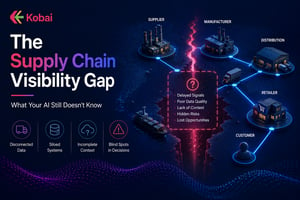
The Supply Chain Visibility Gap: What Your AI Still Doesn't Know
The Supply Chain Visibility Gap: What Your AI Still Doesn't Know
7:41
Your supply chain data has never been more visible. Your supply chain decisions have never been slower to trust.
A question that exposes the gap
A tier-2 resin supplier goes offline without warning. The sourcing manager needs an answer fast:
The question a sourcing manager actually asks: "Which of our approved tier-1 substitutes can absorb the volume without violating a qualified-material requirement on any assembly that depends on it?"
In most organizations, only a handful of people can answer that question quickly, and they answer it from memory. Everyone else waits, or guesses and a wrong guess can mean a substitution that looks fine on paper but breaks a contractual or regulatory requirement no one thought to check.
That delay isn't a data problem. The supplier records, the bill-of-materials, and the qualified-materials list all exist, and they're all governed. The problem is that no system currently holds the relationship between them.
It's not one fact. It's a chain.
Answering the sourcing manager's question means following a chain of relationships, not looking something up in one place:
|
Resin Supplier |
Tier-1 Substitute |
Affected Assembly |
Material Requirement |
Each link depends on the one before it. If any one relationship is missing, outdated, or held only in someone's memory, the chain breaks and so does the answer.
Where Databricks already solves the problem
Databricks has already solved governed access to every dataset in that chain. Supplier records, bill-of-materials, and qualified-materials data all live in one Lakehouse, with Unity Catalog governing who can see what and tracking lineage automatically across every table.
Unity Catalog governs who can access the supplier and assembly data. It doesn't govern how those records relate to one another in the way the business actually works.
That relationship is Enterprise Context, not raw data and it has to be defined once, by people who understand the business, not reconstructed under pressure every time a disruption hits.
From tribal knowledge to Shared Business Context
Kobai helps organizations turn that chain of relationships into Shared Business Context that sits directly on top of the Databricks Lakehouse, governed by the same Unity Catalog policies already in place. Once it exists, the sourcing manager's question can be answered directly, by a person, a dashboard, or an agent, because the chain from supplier to substitute to assembly to requirement is already defined and traceable.
The business impact shows up quickly. Disruption response time drops, because the answer no longer depends on finding the one person who remembers the relationship. Unnecessary supplier changes are avoided, because a substitution can be checked against every downstream requirement before it's approved. Production commitments are protected, because the risk is caught before a shipment goes out on a non-compliant part. And institutional knowledge is preserved as a governed asset, not lost the day a key sourcing lead retires or moves on.
|
Without Shared Business Context |
With Databricks + Kobai |
|
Substitution decisions depend on a few people remembering supplier relationships. |
Substitution options are visible immediately, checked against every governed requirement. |
|
A wrong substitution is caught after the fact, if at all. |
Requirement violations are caught before a substitution is approved. |
|
Institutional knowledge leaves when key staff do. |
Institutional knowledge becomes a durable, governed asset. |
Visibility was never the hard part
The organizations that define their business relationships as carefully as they govern their data will make faster, more confident supply chain decisions.

COMMENTS
