

Organizing Brownfield Data Across Multiple Plants.


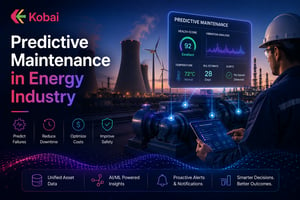
The Outage You Predicted. The Crew That Wasn't There.
The Outage You Predicted. The Crew That Wasn't There.
7:41
It's 6:40am at a regional operations center. Overnight, the predictive maintenance model flagged a gearbox on Turbine 14 showing early signs of bearing wear. The prediction is right, it usually is. The model has months of vibration and thermal data behind it, and this pattern has preceded three failures this year.
The alert goes out. Now the harder question starts: is there a crew within range today? Do they have the right replacement part, or does it need to be pulled from another site's inventory? Is the weather window wide enough to get a technician up the tower before conditions turn?
None of that lives in the model. It lives in three other systems — none of which talk to each other, and none of which were built to answer "can we act on this prediction, right now."
|
The turbine didn't fail because no one saw it coming. It failed because seeing it coming and being able to act on it turned out to be two different problems. |
A familiar shape, across the whole operation
This exact pattern shows up everywhere in energy operations, not just wind. A transformer nearing end-of-life during a heatwave. A compressor on an upstream gathering line trending toward failure. A substation component flagged during storm season. In every case, the prediction arrives on time. The response doesn't.
More often than not, the gap isn't a modeling problem. Predictive maintenance models across the industry have gotten genuinely good at spotting failure patterns early. The gap is what happens in the fifteen minutes after the alert — when someone has to manually check crew locations, part inventory, weather, and site access across systems that were never designed to be checked together.
That coordination tax adds up. Utilities and generation operators lose availability not because they couldn't predict a failure, but because prediction and response live in separate worlds.
Where Databricks already does the hard part
Most energy operators reading this have already done the difficult infrastructure work. Databricks is landing SCADA and IoT telemetry, maintenance history, and workforce data reliably at scale. Unity Catalog is governing access across it. The predictive models — whether built in-house or through a vendor — are running on solid ground.
Unity Catalog governs who can access data brilliantly. What it doesn't govern is what that data means to the business — that "asset" in the SCADA system, "asset" in the maintenance log, and "asset" in the workforce scheduling tool all need to resolve to the same thing before a prediction can turn into a dispatch decision.
Closing the gap between prediction and action
This is where a Business Context Layer earns its place. Rather than treating asset health, maintenance history, crew location, and spare parts as separate systems to be manually cross-referenced, Kobai connects them into a single governed model — directly on the Databricks Lakehouse, under Unity Catalog governance.
Practically, that means the moment a model flags a failing asset, the same query can resolve crew availability, part location, and access constraints — because the relationships between them are already defined, not discovered on the fly during an incident.
|
Prediction alone |
Prediction + business context |
|
|
Asset failure |
Flagged in advance |
Flagged, with root cause and history attached |
|
Crew readiness |
Unknown until someone checks |
Known automatically alongside the prediction |
|
Spare parts |
Confirmed after the fact, often too late |
Confirmed at the moment the prediction is made |
|
Decision owner |
A person, manually cross-referencing systems |
The system, with a person validating the call |
|
Time to respond |
Hours to days |
Minutes |
What changes operationally
→ Predictions arrive with the operational context needed to act on them, not just the technical flag
→ Crew and parts availability is known automatically, not confirmed manually after the alert
→ Response time shifts from hours or days to the time it takes to approve a dispatch
→ Institutional knowledge about failure patterns and past responses is preserved in the model, not in one engineer's memory
The bigger pattern
Every energy operator we talk to has already solved the hard data problem. Fewer have solved the harder one: making sure that once AI tells you something is about to go wrong, your organization can actually respond before it does.
That's not a data platform gap. It's a business context gap and it's solvable without adding new infrastructure or moving data anywhere it doesn't already live.
Databricks provides the platform to see the failure coming. Closing the gap between seeing it and stopping it is a matter of shared context — not another model.
COMMENTS
