

Organizing Brownfield Data Across Multiple Plants.


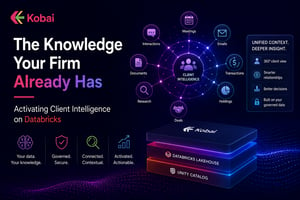
The Knowledge Your Firm Already Has: Activating Client Intelligence on Databricks
The Knowledge Your Firm Already Has: Activating Client Intelligence on Databricks
7:41
Professional services firms don’t just sell projects. They sell experience, relationships, and trust built over decades. Most of that knowledge already exists inside the firm. The challenge is making it visible to the people who need it before the partner meeting, before the proposal, before the client walks out the door.
The information existed. The firm already knew it. The person who needed it couldn’t see it.
A senior partner walks into a client renewal meeting. Three months ago, a junior team in another practice completed a pilot for the same client’s subsidiary in an adjacent region, directly relevant to the expansion the client is about to propose. Nobody told her. The data was in the system. The relationship was on record. The project outcome was documented. None of it was connected to her in time to matter.
This is not a data problem. Professional services firms have more client data than they can use. CRM records, project archives, expertise databases, proposal libraries, win/loss histories — the information exists. What is missing is not the data. It is the shared understanding of how it connects: which clients worked with which teams, on which kinds of engagements, with what outcome, and which of those relationships is relevant right now.
|
The intelligence that wins business is in the connections. |
The institutional knowledge problem
Professional services firms are fundamentally knowledge businesses. The value they deliver is not in the hours billed or the reports produced, it is in the accumulated understanding of industries, clients, technical domains, and how to navigate complex challenges. That understanding lives in the firm’s people: in the partners who have worked in a sector for twenty years, in the project managers who know which approaches have failed and which have succeeded, in the client relationship leads who understand the internal dynamics of key accounts.
When those people are in the room, that institutional knowledge is available. When they are not — when a junior partner is preparing a proposal, when a new team member is taking over a client relationship, when a business development director is building a pitch without the relevant senior partner — the knowledge is invisible. It is not in any system in a form that helps the person who needs it right now.
What firms lose when institutional knowledge stays locked in people’s heads
The commercial consequences are significant and consistent across professional services organizations:
- Proposals written without the most relevant past experience, because the team did not know it existed
- Cross-sell opportunities missed because the left hand does not know what the right hand has already delivered to the same client
- Client relationships lost when the partner who owned them leaves, taking institutional understanding of the account with them
- New team members taking months to become effective because the context that experienced colleagues hold informally is not accessible
- Senior partner time spent sharing context that should already be available, instead of applying judgment that only they can provide
These are not data problems. Every firm has enough data. They are connection problems — the absence of a shared, accessible model of how clients, projects, expertise, relationships, and outcomes connect to each other.
|
The knowledge that walks out the door One of the most acute versions of the institutional knowledge problem is senior partner departure. When a partner who has managed a major account for a decade leaves, they take with them not just the relationship but the accumulated understanding of that client’s priorities, decision-making patterns, past sensitivities, and the context of every engagement. Firms that have connected that knowledge into a shared model retain it. Firms that have not started over. |
The questions that connected intelligence answers
When client knowledge, project history, expertise, and relationship data are connected in a shared model on the Databricks Lakehouse, the commercial questions that professional services firms actually care about become answerable quickly and without analyst intermediation.
|
Commercial question |
What the firm can now do |
|
Which past projects are most relevant to this proposal? |
Project history connected to client type, sector, geography, and scope surfaces the most credible analogues in minutes including work done in other practice groups the proposal team may not know about. |
|
Who in the firm has the right expertise and relationships for this client? |
Expertise records and existing client relationships connected to identify the team members with both the relevant skills and the strongest pre-existing client relationships, not just whoever is available. |
|
Which clients are at renewal risk? |
Engagement frequency, delivery performance, and relationship health connected to identify clients with declining interaction patterns before the renewal conversation becomes difficult. |
|
Where are our cross-sell opportunities? |
Client purchase history across practice groups connected to the full service portfolio. Clients who have bought from one practice and not another, where comparable clients have expanded, become visible systematically rather than by accident. |
|
What do we already know about this prospect? |
Relationship history, alumni connections, past interactions, and analogous client profiles surfaced before the first meeting — so the firm walks in knowing more than the prospect expects. |
Why transactional platforms often don’t solve the professional services problem
Many professional services firms have explored Customer Data Platforms and similar technology in response to these challenges. CDPs solve important problems — consolidating customer interaction data, driving marketing personalisation, and unifying contact records at scale. For firms operating at high transactional volumes, those capabilities are valuable.
For many professional services firms, however, a traditional CDP does not solve the commercial intelligence problem. The challenge is not transactional data volume. It is relational modelling: which past project is analogous to this opportunity, which team member has the relationships this pursuit requires, which client outcomes are relevant to this proposal. Those are connection questions, not contact record questions and they require a different kind of model.
|
What transactional platforms handle well |
What professional services firms actually need |
|
High-volume customer interaction data |
Low-volume, high-context client relationship intelligence |
|
Marketing personalization and campaign targeting |
Proposal intelligence and business development context |
|
Contact-level behavioral profiles |
Multi-entity models: clients, projects, expertise, outcomes, relationships |
|
Centralized customer record management |
Connected institutional knowledge accessible to the whole firm |
How connected client intelligence works on the Databricks Lakehouse
The architecture for connected client intelligence on Databricks follows a straightforward pattern. The data already exists — in Salesforce, in the project management system, in HR and resourcing tools, in document management. The work is not collecting more data. It is connecting what is already there.
Step 1: Connect existing data sources
Kobai Precursor uses AI to analyze existing Delta Tables on the Databricks Lakehouse and recommend how data from CRM, project systems, HR, and financial platforms maps to a shared client intelligence model. Business development leaders and client relationship managers review and approve the recommendations. The data engineering effort required to connect diverse source systems is significantly reduced without sacrificing the precision that domain experts bring to validating the connections.
Step 2: Define what client relationships mean
Kobai Studio gives relationship partners and practice leaders a no-code visual environment to declare what matters: which clients relate to which projects, how past outcomes are classified, which expertise is relevant to which client types, and what signals indicate renewal risk or cross-sell opportunity. The model is authored by the people who understand the commercial domain — not by data engineers approximating what they meant. It is stored as a governed object within Unity Catalog, versioned and auditable.
Step 3: Make it available through Genie and firm applications
The connected model becomes available to every commercial tool the firm uses. As organizations deploy Databricks Genie across business development, practice leadership, and client management, maintaining consistent definitions of clients, projects, sectors, and outcomes becomes increasingly important. A shared client intelligence model ensures every Genie space draws from the same connected understanding so the partner preparing for a pitch and the practice head reviewing the pipeline work from the same picture. The same model also surfaces relevant context directly within proposal tools and client review workflows, without requiring a separate query.
What this looks like in practice
The commercial impact of connected client intelligence is most visible in specific situations that professional services firms encounter repeatedly.
The competitive pitch
A mid-size architecture firm is invited to pitch for a sustainable infrastructure programme for a regional government client. The pitch team, assembled the week before the deadline, includes two partners but neither has worked directly with this client type before. With connected client intelligence, the team can immediately surface: every analogous project the firm has completed in the public sector infrastructure space in the past five years, the partners and project managers who led those engagements, the outcomes and client testimonials available, and any existing relationships between firm alumni and the prospect’s procurement team. The pitch is grounded in institutional knowledge the team did not know they had access to.
The partner succession
A senior partner who has managed a major financial services account for eight years announces their departure. The account represents significant revenue and a long-standing relationship. With connected client intelligence, the handover is not a scramble to reconstruct eight years of relationship history from email threads and meeting notes. The successor inherits a connected picture: the full engagement history, the client’s stated and revealed priorities, the internal stakeholders and their relationships with specific firm members, and the context of every major project decision. Institutional knowledge that would previously have walked out the door stays in the firm.
The cross-sell that was hiding in plain sight
An engineering consultancy’s sustainability practice has delivered five successful projects for clients in the firm’s infrastructure portfolio. None of those infrastructure clients have been introduced to the sustainability practice. With connected client intelligence, this gap is visible systematically, not dependent on a partner happening to mention it in a cross-practice meeting. The business development team can identify every infrastructure client where comparable firms have expanded into sustainability work, and prioritize outreach accordingly.
|
The intelligence that wins business is in the connections. And those connections are already inside the firm — in project records, relationship histories, expertise databases, and the accumulated experience of the people who built the practice. |
What connected institutional knowledge changes for the firm
Firms that make institutional knowledge accessible and connected, rather than siloed and person-dependent, can expect improvements across the commercial activities that determine growth and retention.
|
Activity |
How connected intelligence changes it |
|
Proposal preparation |
Teams access relevant past projects, client context, and expertise without depending on a senior partner to recall it from memory. Proposals become more grounded and more credible. |
|
Client retention |
Renewal risk is visible before the renewal meeting. Account history, delivery performance, and relationship health are connected into an early warning picture rather than discovered in retrospect. |
|
Cross-selling |
Adjacent opportunities are identified systematically from client purchase patterns, not from partner conversations at practice leadership meetings. The gaps become visible to everyone. |
|
New partner onboarding |
Successors and new relationship leads access the full client context from day one. The weeks previously spent in relationship reconstruction conversations are redirected to client-facing work. |
|
Succession planning |
Institutional knowledge is connected into the model before it walks out the door. The departure of a long-tenure partner does not mean the loss of the relationship intelligence they carried. |
|
Senior partner leverage |
Senior partners spend their time applying judgment and relationships rather than sharing context that should already be available. Their leverage improves because the organization does not depend on them as an information relay. |
Databricks + Kobai: Connected institutional intelligence for professional services
Databricks provides the Data Intelligence Platform. Kobai helps professional services firms create, govern, and operationalise the shared client intelligence model that makes institutional knowledge accessible to the people who need it — before the pitch, before the renewal, before the partner departs.
Firms using this approach can expect to surface relevant past experience faster in proposal preparation, identify cross-sell opportunities systematically rather than opportunistically, and retain institutional knowledge through partner transitions that would previously have resulted in significant relationship disruption. The data to make all of this possible is already in the Databricks Lakehouse. The model that connects it is what Kobai builds.
Graph structures are built directly within Databricks under Unity Catalog governance. The client intelligence model is defined by business development leaders and client relationship managers using Kobai Studio — the people who understand what commercial relationships actually mean. Every Genie space, every agent, and every application draws from the same connected model.
|
To explore how Databricks + Kobai can help your professional services firm unlock the client intelligence already inside your organisation, visit kobai.io or contact us at contact@kobai.io. |

COMMENTS
