

Organizing Brownfield Data Across Multiple Plants.


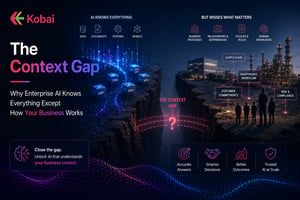
The Context Gap: Why Enterprise AI Knows Everything Except How Your Business Works
The Context Gap: Why Enterprise AI Knows Everything Except How Your Business Works
7:41
Your AI has read every contract, every ticket, every table in the warehouse. Ask it a business question, and it still gets it wrong, not because it lacks data, but because it doesn't know what your business means by the words in the question.
The gap that survives every data investment
Most enterprises have spent the better part of a decade solving for data. They've consolidated it, governed it, and made it accessible at a scale that would have been unthinkable ten years ago. On Databricks, that work has genuinely paid off: Unity Catalog gives teams one governance model across every table, model, and agent, with lineage tracked automatically from raw source to output.
And yet CIOs and CDOs keep running into the same wall. Two AI assistants, pointed at the same governed data, give two different answers to the same question because "customer," "at-risk," or "critical" mean something slightly different depending on which team built the underlying logic. The data was never the problem. The problem is that no one ever wrote down, in a form the AI could use, what the business actually means by the words it reasons with.
Enterprise AI has read everything. It still doesn't know what your business means by "at-risk," "critical," or "customer."
Two kinds of maturity, rarely built together
It helps to separate two things that get conflated constantly: data maturity and context maturity. Data maturity is about access, quality, and governance whether the right data exists, in the right place, under the right controls. Most large enterprises on Databricks have made real progress here.
Context maturity is different. It's about whether the business concepts behind the data — what a customer is, what makes a supplier critical, what "on-time" means for a given contract — are defined once, consistently, and made available to every system reasoning over that data. Very few enterprises have built this deliberately. It tends to live instead in spreadsheets, tribal knowledge, and the heads of a handful of long-tenured employees.
|
Data Maturity |
Context Maturity |
|
Data is centralized and access-controlled. |
Business meaning is centralized and consistently applied. |
|
Every team can query the same tables. |
Every team reasons from the same definitions. |
|
Governance answers "who can see this." |
Context answers "what does this mean, and to whom." |
|
AI has broad access to enterprise data. |
AI has a governed understanding of enterprise meaning. |
The organizations furthest ahead on AI are not necessarily the ones with the most data. They are the ones that have closed the gap between these two kinds of maturity.
Why this gap is becoming more expensive, not less
As AI moves from answering isolated questions to acting across the business — recommending a supplier substitution, reprioritizing a maintenance queue, flagging a customer at risk — the cost of an undefined business concept compounds. A dashboard with an inconsistent definition is an annoyance. An agent acting autonomously on an inconsistent definition is a liability.
This is exactly why platforms like Databricks have invested so heavily in governance and in tools like Genie and AI/BI: the platform capability to reason and act is now genuinely there. What determines whether that capability produces trustworthy outcomes is not the model. It's whether the business context behind the question was ever defined in a form the AI could use.
Closing the gap is a leadership decision, not an engineering one
Closing the context gap isn't primarily a data engineering exercise. It requires the people who understand how the business actually works — in operations, in finance, in supply chain — to define that meaning once, and requires that definition to be governed with the same rigor as the data itself, extending naturally from the access controls already in place on platforms like Databricks. That is a Business Context Layer: context that is created, governed, and made available consistently across every AI system, dashboard, and agent that needs it.
This is why closing the context gap is ultimately a leadership decision. It requires deciding that business meaning is worth governing as deliberately as data access has been and assigning ownership of that meaning to the people who understand the business, not leaving it to whoever happens to write the next query.
What separates AI leaders from AI experimenters
Every enterprise now has access to roughly the same AI capability. What separates the organizations getting real value from AI from those still running pilots is rarely the sophistication of the model. It's whether someone took the time to define, once and clearly, what the business actually means by the words the AI is asked to reason about.
The organizations that treat business context as a governed asset, not an afterthought, will be the ones whose AI can be trusted to act, not just to answer.

COMMENTS
