

Organizing Brownfield Data Across Multiple Plants.


The Lakehouse architecture solved a problem that had frustrated enterprises for years.
The Databricks Lakehouse architecture unified data engineering, analytics, and machine learning into a single platform. As organizations begin deploying copilots and autonomous AI agents on the Databricks Data Intelligence Platform, a new challenge is emerging: enabling AI systems to reason across enterprise data.
For a long time, organizations were forced to choose between data warehouses built for analytics and data lakes built for scale. The Lakehouse unified these worlds. Data engineering, analytics, machine learning, and governance could all operate within the same platform.
For many companies, this represented a major step forward in how data infrastructure was built. As organizations begin deploying copilots and autonomous AI agents, the next evolution of the data platform is emerging.
Enterprises are no longer just asking:
How do we store data?
How do we analyze data?
They are asking something more ambitious.
How do we enable systems to reason across our enterprise data? - This is where the next evolution of the Lakehouse begins!
This is a very different problem. Reasoning requires context. It requires understanding how entities relate to one another across systems. Without that context, even the most advanced analytics platforms remain limited to processing data rather than interpreting it.
One architectural principle is becoming increasingly clear as organizations build AI systems on the Lakehouse. The semantic model of the enterprise should live alongside the data itself. Historically, knowledge graphs and semantic models were implemented in separate graph databases. While powerful, this often introduced additional infrastructure, synchronization pipelines, and separate governance models.
In a Lakehouse architecture, a different approach becomes possible.
Instead of moving data into a graph platform, organizations can define semantic models directly over governed Lakehouse data. This allows entities, relationships, and business meaning to be expressed without duplicating data or introducing a second system of record.
This approach preserves the architectural integrity of the Lakehouse while enabling graph-style reasoning and enterprise AI workloads.
This is where the concept of enterprise intelligence begins to emerge.
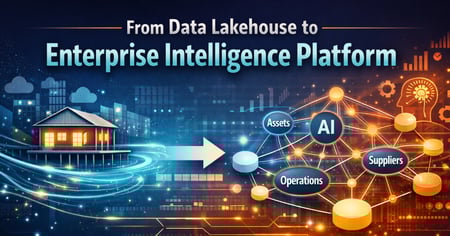
Enterprise intelligence is not just about analytics dashboards or machine learning models. It is about creating a connected understanding of how an organization operates. Assets, suppliers, customers, engineers, contracts, and operational events all become part of a shared model of enterprise reality. When this model exists, data stops being isolated tables. It becomes a connected network of meaning.
The Lakehouse provides the infrastructure for storing and governing enterprise data. Semantic models provide the structure that allows systems to understand how that data relates together. When these two capabilities come together, organizations move from managing data to enabling enterprise intelligence. Platforms such as Kobai implement this semantic capability directly within the Databricks Lakehouse by allowing organizations to define enterprise entities, relationships, and business meaning over governed Lakehouse data. Because these semantic models execute on Databricks compute and inherit governance from Unity Catalog, organizations can enable graph-style reasoning and AI-driven intelligence without introducing a separate graph database or system of record.
AI systems can navigate relationships across the enterprise. Decision systems can reason across operational context. Insights become easier to explain and trust. Best of all, this connected intelligence is built directly over existing tables, meaning enterprises can achieve graph-like reasoning without moving their data or introducing a second system of record.
In many ways, the evolution is simple. First we built platforms to store data. Then we built platforms to analyze data. The next step is building platforms that allow organizations to understand their data as a connected system.
That is the shift from a data platform to an enterprise intelligence platform.

COMMENTS
